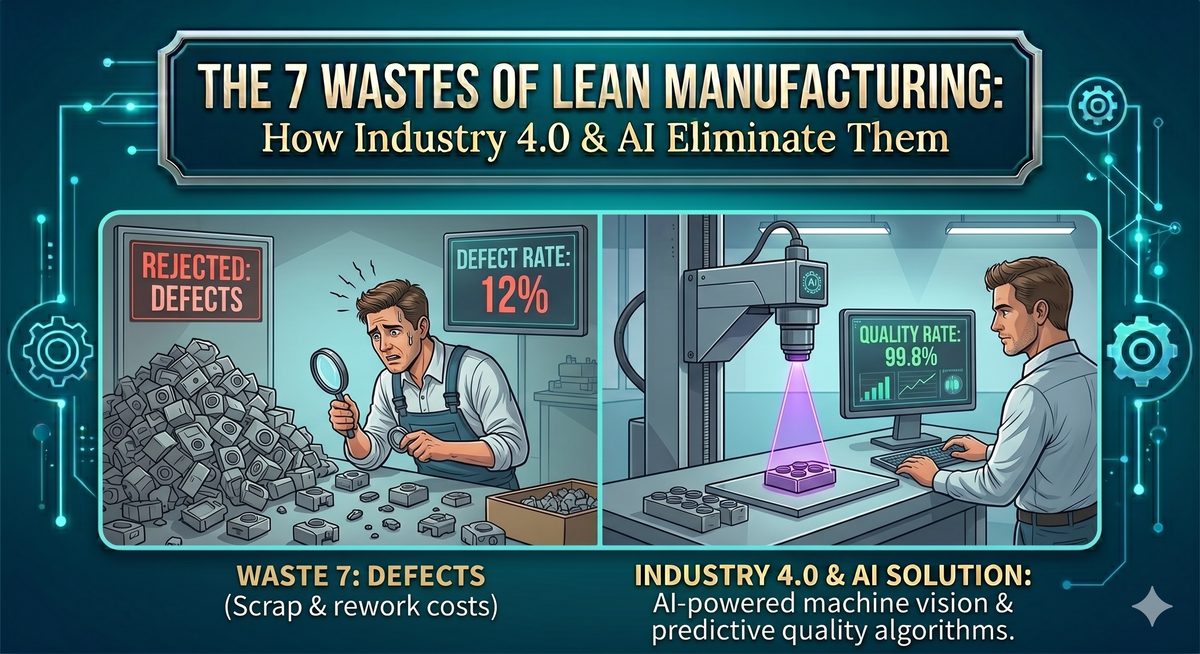
At the core of Lean thinking sits a single, relentless question: what work actually adds value for the customer — and what doesn't? Everything that doesn't is waste, or Muda in the original Japanese of the Toyota Production System. Lean identifies seven classic wastes, easily remembered by the acronym TIMWOOD.
The 7 wastes of Lean (TIMWOOD)
- Transport — unnecessary movement of materials or products between locations, which adds cost and risk of damage but no value.
- Inventory — excess raw materials, work-in-progress, or finished goods tying up cash and hiding problems.
- Motion — wasted movement by people or equipment, like reaching, walking, or searching for tools.
- Waiting — idle time when people, machines, or materials sit waiting for the next step.
- Overproduction — making more, or sooner, than the customer needs. Often considered the worst waste because it generates the others.
- Overprocessing — doing more work than required, such as unnecessary inspections, polishing, or features customers don't value.
- Defects — errors that require rework, scrap, or correction, consuming time, material, and trust.
Many practitioners add an eighth waste — the underutilization of human talent and skills — but the original seven remain the foundation.
Why it matters most in manufacturing
While Lean principles now reach healthcare, software, and services, the seven wastes were born on the factory floor, and that is still where they bite hardest. Manufacturing runs on thin margins, high volumes, and tightly linked processes, so a small inefficiency multiplies fast. A few seconds of unnecessary motion per cycle, repeated across thousands of units and multiple shifts, becomes thousands of lost hours a year. Excess inventory ties up working capital and conceals quality problems. A single recurring defect can trigger costly recalls and damage a brand built over decades.
Manufacturing also makes waste visible in a way that knowledge work rarely does — physical inventory piles up, machines visibly idle, scrap bins fill. That visibility is exactly why the discipline took root here first, and why factories remain the proving ground for every new wave of Lean tools.
How Industry 4.0 and AI identify, minimize, and prevent waste
The newest of those waves is digital. Where traditional Lean depended on a trained eye walking the floor, Industry 4.0 and AI now detect waste continuously, at a scale and speed no human team can match. The shift moves Lean from reactive cleanup to real-time prevention.
Identify. Connected sensors and the Industrial Internet of Things (IIoT) stream live data from every machine and process. Process-mining software reconstructs how work actually flows — not how a diagram says it should — exposing hidden bottlenecks, waiting, and unnecessary transport automatically. AI vision systems flag defects on the line in milliseconds; Siemens, for example, has standardized AI-enabled visual inspection across factories with measurable savings per workstation.
Minimize. Machine-learning models analyze patterns across thousands of signals to optimize in ways manual analysis can't. Predictive maintenance forecasts equipment failure before it happens, slashing the waiting waste of unplanned downtime. AI-driven demand forecasting and digital Kanban right-size inventory and curb overproduction, while digital twins let engineers simulate process changes virtually before touching the real line — eliminating overprocessing and trial-and-error waste.
Prevent. This is where the real leap lies. By digitizing the Plan-Do-Check-Act cycle, modern platforms turn improvement into a continuous loop rather than a periodic event. Automated alerts trigger corrective action the moment a process drifts, stopping defects before they propagate. This is the essence of Digital Kaizen — pairing the human discipline of continuous improvement with machine precision so that waste is designed out, not just cleaned up.
A practitioner's perspective: you can't fix what you don't measure
In my own experience, measurement is the part that decides whether waste reduction succeeds or stalls. Too often, decisions on the floor are made on gut feel rather than data — and gut feel quietly tolerates waste it can't see. This is where IIoT and sensors change the game: by measuring what is actually happening, they let us separate the real waste from the assumed waste and build genuinely preventive actions around it.
In several applications, I've used computer vision to identify the seven wastes directly on the line, and I'd argue it's one of the fastest ways to understand what is truly going on. A camera and a trained model can watch motion, waiting, and defects unfold in real time and surface patterns that would take weeks to spot by hand. Measurement first, then improvement — in that order — is what turns Lean from an opinion into a discipline.
The bottom line
The seven wastes have guided manufacturers for over half a century, and they are not going away. What has changed is our ability to see and stop them. Industry 4.0 supplies the data and AI supplies the intelligence, but the goal remains the one Toyota set decades ago: deliver maximum value to the customer with minimum waste. The factories that combine timeless Lean principles with modern technology won't just find waste faster — they'll prevent it from ever occurring.