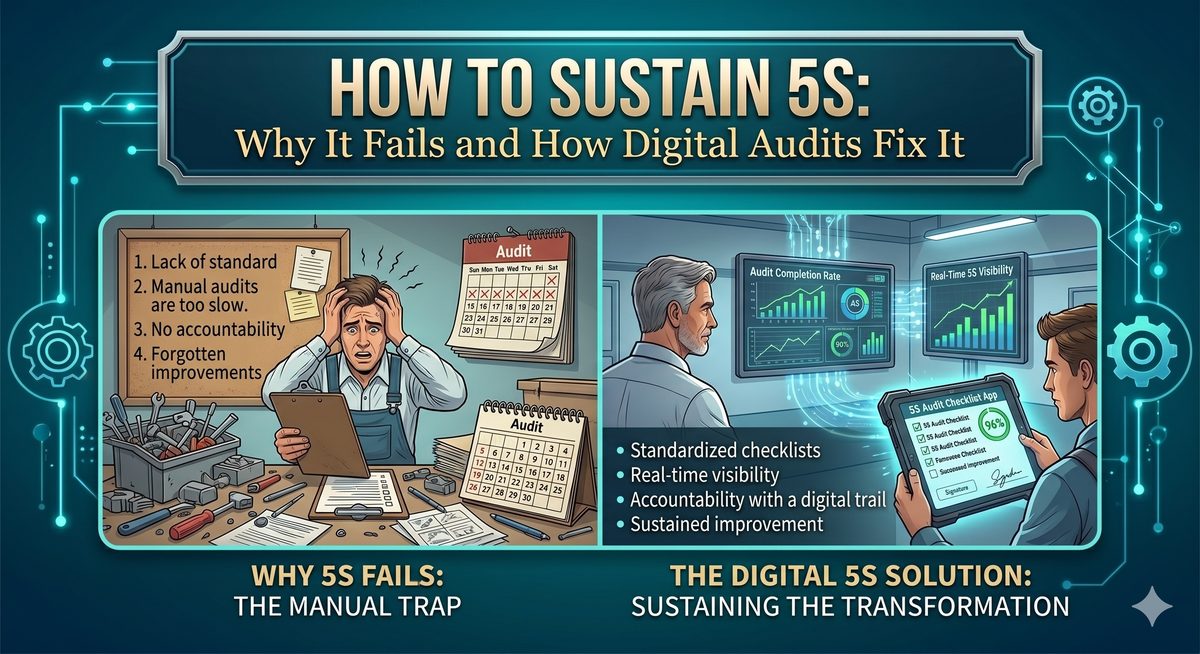
Almost every manufacturer has launched a 5S program. Far fewer have kept one alive. The first four S's — Sort, Set in Order, Shine, and Standardize — deliver a visible transformation in weeks. It's the fifth S, Sustain, that quietly defeats most organizations. Within months, the red tags fade, tools drift back to wherever is convenient, and the spotless workplace slips back to where it started. Understanding why sustenance fails — and how a disciplined audit mechanism prevents it — is the difference between a one-time clean-up and a permanent shift in how a plant operates.
The top 5 reasons 5S sustenance fails
- It's treated as a one-time event. Teams launch 5S as a project with an end date rather than a daily habit. Once the kickoff energy fades, so does the discipline.
- No ownership. When everyone is responsible, no one is. Without named area champions, standards drift because nobody feels accountable for holding the line.
- Weak or inconsistent audits. Sustaining requires regular checking. Where audits are irregular, subjective, or skipped under production pressure, slippage goes unnoticed until it's severe.
- Lack of visibility and feedback. Findings buried in a binder never reach the people who can act. Without fast, visible feedback, problems repeat.
- No recognition. Effort that goes unrewarded gets abandoned. When sustaining 5S brings no acknowledgment, teams reasonably conclude it doesn't matter.
Notice that four of these five failures are about behavior and follow-through, not the physical workplace. That is precisely why auditing is the engine of the Sustain phase.
How audits power the Sustain phase
An audit converts 5S from a hope into a measured discipline. A good audit does three things: it sets a clear standard, it checks reality against that standard on a regular rhythm, and it makes the gap visible so it can be closed. Done consistently, audits create the gentle, repeated pressure that turns a tidy workplace into an ingrained habit.
But the format of the audit matters enormously — which brings us to the single biggest practical upgrade available today.
From paper to app: why digital audits transform results
Traditional 5S audits live on paper checklists. They work, but they leak value at every step: paper sits in a folder, scoring is subjective, trends are invisible, and findings take days to reach the floor. In my own experience, moving from paper checklists to a mobile audit app changed everything. Digital audits are quicker to perform, data is retrieved instantly, communication is immediate, and you can finally see the development pattern over time and track stage-wise progress area by area.
The gains are concrete:
- Speed: audits that took an hour take minutes, so they actually get done.
- Visibility & transparency: scores, photos, and trends are visible to everyone in real time.
- Communication: non-conformances are assigned and notified instantly, closing the feedback loop.
- Pattern recognition: dashboards reveal which areas are improving, which are slipping, and where to focus.
Most importantly, this discipline delivered a real safety dividend. An unorganized floor with poorly stored, improper tools is a leading cause of hand injuries. After implementing 5S and sustaining it through digital audits, we saw hand-injury rates fall significantly. A well-organized workplace isn't just tidier — it's measurably safer.
A simple sustain framework any practitioner can follow
You don't need a complex system to start. Follow this loop:
- Standardize a clear, photo-based 5S checklist for each zone.
- Assign a named champion to every area — ownership is non-negotiable.
- Audit on a fixed rhythm (weekly or biweekly) using a mobile app, with photos and instant scoring.
- Act on findings immediately, assigning corrective actions with owners and due dates.
- Review trends monthly to spot patterns and recognize improvement.
- Recognize results — celebrate wins, award and certify high-performing areas and champions.
The guiding principles are simple: start small, involve the team, remember 5S is not a one-time activity, celebrate success, and certify your champions and areas. Sustain it, and safety improves as a natural by-product.
Take it further: healthy internal competition
In India, the Confederation of Indian Industry (CII), through its Institute of Quality, runs respected national competitions recognizing improvement and quality excellence across industries. The same spirit works powerfully inside a single organization. A friendly inter-departmental 5S competition — scored through the digital audits described above — taps natural pride and turns sustaining 5S from a chore into something teams want to win. Digitizing the scoring keeps it fair, transparent, and effortless to track.
Sustaining 5S was never really about cleaning. It's about building a culture of discipline, visibility, and recognition — and modern digital audits finally make that culture easy to maintain.