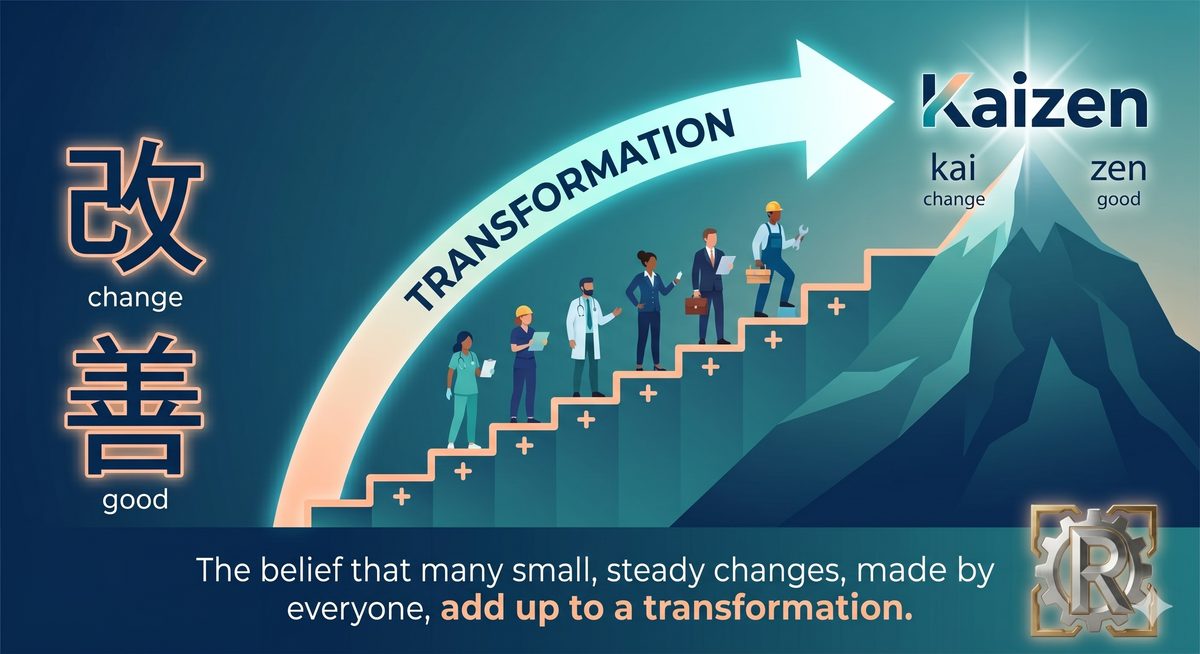
Kaizen is one of those rare business ideas that is simple enough to explain in a sentence yet powerful enough to have reshaped global manufacturing. At its heart, Kaizen is the practice of continuous, incremental improvement — the belief that many small, steady changes, made by everyone in an organization, add up to a transformation that no single grand initiative could achieve.
The word itself is Japanese, combining kai (change) and zen (good): literally, "change for the better." But Kaizen is more than a translation. It is a mindset and a management system that turns improvement from an occasional project into a daily habit. To understand why it matters — and where it is heading — it helps to trace its journey across three eras: where it came from, how the world uses it now, and what artificial intelligence is about to do with it.
The past: how Kaizen was forged in post-war Japan
Kaizen was born out of necessity. After the Second World War, Japan's industrial base lay in ruins, and Japanese companies faced the urgent task of rebuilding and catching up with the West. American experts sent to help — most famously the statistician W. Edwards Deming, alongside Joseph Juran and the wartime Training Within Industry program — brought ideas that would prove foundational. Deming argued that quality should be built in at every stage of production and placed directly in the hands of frontline workers, championing the Plan-Do-Check-Act (PDCA) cycle that still anchors Kaizen today. He trained hundreds of Japanese engineers, managers, and executives in this data-driven, root-cause approach.
Japanese industry absorbed and adapted these lessons, and the company that became the spiritual home of Kaizen was Toyota. As early as 1950, Toyota was forming quality circles — small groups of workers who met regularly to identify and solve problems in their own work. Under engineer Taiichi Ohno, these practices matured into the Toyota Production System (TPS), the methodology the West would later call "lean production." What made TPS distinctive was its focus not on improving individual machines but on the flow of the entire system, from raw material to finished product. Toyota refined now-legendary concepts in the process: Just-in-Time production, Kanban for managing workflow, and Poka-Yoke for mistake-proofing — all aimed at eliminating waste, easing overburden, and making quality consistent.
The results spoke for themselves. The leap in quality and the drop in cost sent demand for Japanese products soaring and expanded Japan's share of the global market through the second half of the twentieth century. For years, this was a largely Japanese secret. That changed in 1986, when management consultant Masaaki Imai — who had worked alongside Taiichi Ohno and founded the Kaizen Institute in 1985 — published Kaizen: The Key to Japan's Competitive Success. Translated into more than a dozen languages, the book introduced the term to business communities in Europe and North America and earned Imai the lasting title of "the father of Kaizen." His later work, Gemba Kaizen, took the philosophy onto the shop floor — the gemba, or "the real place" where value is created.
The present: Kaizen goes global and crosses every industry
What started on Japanese assembly lines is now everywhere. The methodology that Toyota, Canon, Sony, and Samsung built their reputations on has spread far beyond automotive manufacturing into healthcare, financial services, software, logistics, retail, and the public sector. Just as importantly, Kaizen has migrated beyond the factory floor and into business functions that its founders never imagined.
A telling example is the Danaher Corporation, often credited as the pioneer of "growth Kaizen" — extending continuous improvement out of operations and into sales, marketing, and innovation. The same mindset that once shaved seconds off a machine cycle is now used to shorten sales cycles and accelerate product development. In healthcare, hospitals apply Kaizen to reduce patient wait times, cut medication errors, and optimize the flow of work through wards and clinics, increasingly pairing it with data-driven techniques like process mining.
Even the world's largest technology companies have rediscovered it. Microsoft's chief operating officer has publicly credited Kaizen — and the principle of putting people and processes before technology — as a driving force behind the company's transformation into an AI-first organization. The reason the philosophy endures is its adaptability: in a fast-moving market, a culture of small, continuous improvements lets a business respond to shifts in technology or customer demand far faster than one that waits for the next big reorganization.
The everyday tools of present-day Kaizen remain recognizably the same ones Toyota developed: the PDCA cycle, 5S workplace organization, Gemba walks, the hunt for the seven wastes (Muda), and focused Kaizen events or "blitzes" where a cross-functional team attacks a single problem over a few intense days. What has changed is the breadth of where these tools are applied — and, increasingly, the technology that powers them.
The future: AI and the rise of "Digital Kaizen"
The next chapter of Kaizen is being written in data. Industry watchers have begun calling it "Digital Kaizen" or "Kaizen 2.0" — the evolution from the manual suggestion box and the clipboard on the shop floor to a real-time, data-driven discipline supercharged by artificial intelligence. The core objective hasn't changed; the goal is still to eliminate waste and improve continuously. What changes is the speed and precision with which improvement opportunities are found and acted upon.
Here is what that shift looks like in practice:
From reactive to predictive. Traditional Kaizen relies on humans noticing a problem and then investigating it. AI and machine learning flip that around. By analyzing thousands of signals from sensors, transactions, and systems, predictive analytics can surface inefficiencies and likely failures before they cause disruption — a kind of "predictive Kaizen" that spots the problem while it is still small.
From periodic to continuous. Improvement no longer has to wait for the quarterly review or the scheduled Kaizen event. When operational data flows continuously and routine fixes can be automated, progress can happen in real time. The PDCA cycle itself is being digitized, with platforms capturing data, analyzing root causes, and triggering action almost instantly.
From manual inspection to intelligent maintenance. On the modern factory floor, Total Productive Maintenance is increasingly AI-powered. Operators scan a code on a machine, log a visual check on a mobile app, and instantly trigger a maintenance request — bridging the long-standing gap between operations and maintenance that Kaizen always sought to close. Manufacturers such as Siemens have standardized AI-enabled visual inspection across factories with clearly measurable savings per workstation.
From data scarcity to insight abundance. Natural language processing and machine learning can read patterns across vast datasets that no human team could process manually, turning raw operational noise into actionable insight — and even into recommended improvements.
None of this makes the human element obsolete; if anything, it makes it more important. The enduring lesson from Microsoft and others is that technology comes after people and process, not before. The most successful organizations treat AI as an ally that handles pattern-finding and automation, freeing people to do what they do best: exercise creativity, judgment, and ownership. For practitioners, preparing for this future means a few concrete steps — mapping existing processes to see where data and automation could accelerate insight, investing in the data infrastructure that continuous improvement now depends on, empowering cross-functional teams with both AI-driven insight and the autonomy to act, and updating Kaizen training to include data literacy and AI fundamentals alongside the classic tools.
Why Kaizen still matters
Across nearly eight decades, the through-line has never broken. Whether it was a quality circle at Toyota in 1950, a Kaizen blitz in a modern hospital, or an AI model flagging a defect in real time today, the underlying idea is identical: improvement is everyone's job, it happens through small steady steps, and it never stops. The tools have evolved from suggestion boxes to algorithms, but the philosophy — change for the better, every day — is as relevant in the age of AI as it was in post-war Japan. Organizations that pair the discipline of Kaizen with the power of modern technology are positioned to do what every Kaizen practitioner has always aimed for: to get a little better, today, than they were yesterday.